
History of Kathak
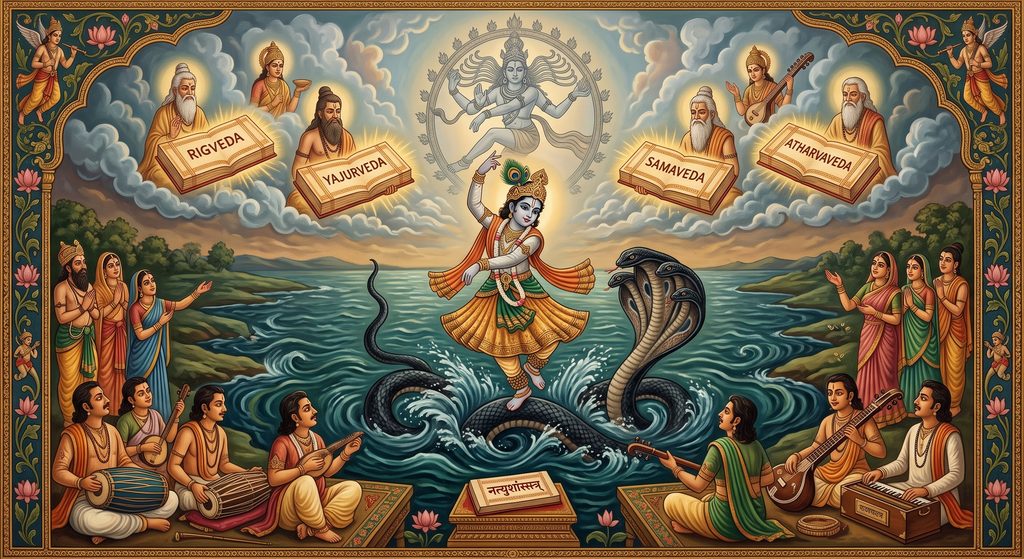
Building upon the temple roots and the role of Kathakars as illustrated in the ancient Indian timeline, the origin of Kathak’s narrative style is rooted in a fundamental story of ancient Bhartiya times.
This ancient story relates that the gods and sages, led by Lord Indra, approached the creator Lord Brahma, asking for a fifth Veda—a Natyaveda (Veda of Dramatic Art)—that could be accessible to all. Brahma agreed and instructed the sage Bharata Muni, who combined elements from the four existing Vedas: word and recitation from Rig Veda, music from Sama Veda, gesture and mime from Yajur Veda, and emotion from Atharva Veda. This story establishes that the very core of all Indian classical dance, including Kathak, is to be a visual and musical narration. The earliest Kathakars, depicted in the image, utilized these principles to bring theoretical concepts of ‘bhava’ (emotion) and ‘abhinaya’ (expression) to life in temple courtyards.
A unique and profound dimension of Kathak’s historical development also ties its rhythmic foundation to Lord Krishna. In addition to the storytelling focus described in the Medieval Bhakti Era, there is a core belief that the very first bols (syllabic sounds) of Kathak mimic the divine, playful steps of child Krishna, the ‘Balakrishna’. The fundamental sounds of tatkar footwork, and other percussive sounds such as ‘tat’, ‘ta’, and ‘dei’, are traditionally thought to echo the natural, tiny rhythmic patterns and impact of Lord Krishna’s toddling footsteps as he first learned to walk. This deep theological connection makes the basic language of Kathak rhythm an echo of divine creation and play.